Tuesday, April 21, 2009

Take Off Your Blindfolds! It's NOT Pin the tail on the Donkey!


Never before in the post-war era have U. S. investors had to deal with a crippled financial system, such monumental depth and breadth of change, and a pervasive uncertainty about the future. And, never in any modern era have we had to do so while also experiencing the waning of our nation’s global economic power, international prestige, and internal potential for future growth.

Even more importantly, never before have U. S. investors had to deal with the kind of investment markets produced by this new economic environment – investment markets that lack the underpinnings of a consistently growing and increasingly productive economic base. In this previously unknown environment, most investors will be essentially investing blind.


The reasons behind the gradual dissipation of the foundational substance of our nation and economy are many, varied, and controversial. So, I will leave the explanations and evaluations of the causes (e. g., the opinions) to the political pundits and economic editorialists.

The more important issue is this: What can investors do to protect their lifestyles and preserve their economic legacies in this extremely hostile financial environment?

At CoreStates Capital Advisors, we have been pondering this question since well before the severe market erosion began. Our approaches will continue to develop and evolve, of course, but the following are some of the key concepts, strategies and tactics we have been implementing for our clients in our pursuit of investment success in this new environment.

21st Century Diversification
The four-cylinder portfolios (stocks, bonds real estate and cash) of the 1980s gave way to the eight cylinders (adding energy, precious metals, commodities and currencies) of the 1990s, but success in the 21st century will require all of this, plus the ability to be long or short in each category, and with manager discretion within each of the categories to move among style boxes, or even to abandon the style box concept for a more opportunistic approach.

Emphasis on Liquidity
An investment’s returns become “real” only when the investment is sold. Until then, they are only on paper. But, when sold, the return is locked in. So, it is critically important never to be forced to sell an investment, especially a highly priced volatile investment, at an inopportune time. The only way to achieve this is by maintaining enough liquidity in price-stable form or in truly uncorrelated assets to meet any scheduled or unscheduled cash needs.

Dynamic Allocations
The days of fixed allocations . . . never really existed. Going forward, dynamic allocations will become even more important as most markets see their historically upward bias diminish or even reverse, making all markets into trading markets and generously rewarding those investors able to capitalize on their inherently higher volatility.

End of Indexing
The days of buy-and-hold investing are also over. Active security selection will be more important than ever as increasing global competition as well as the mounting geopolitical challenges make the generation of corporate earnings increasingly difficult. In a flat-to-declining overall economy, “par” corporate performance will be insufficient to provide attractive returns to shareholders or even to maintain long-term credit quality. We must invest accordingly.

Focus on quality and valuation
The easy investment approach for the coming years will be to focus on quality . . . and settle for near-zero nominal returns in a potentially high-inflation environment. True growth of purchasing power will be achieved only by correctly evaluating investment quality and being willing to trade among quality levels based on their current relative valuations.

Polar Portfolio Positioning
Implement all of the above points and you are likely to find yourself with a “polar” portfolio – one consisting primarily of some very high quality, liquid assets and some very cheap, but rather speculative, exposures. Middling opportunities are likely to provide piddling returns as most investors seek to improve on low risk, low return investments by edging up the risk spectrum, thereby bidding up prices and diminishing their returns.

Importance of Judgment
Investing driven by historically based, “black box” models becomes less and less effective as the future becomes less and less like the past. The sea change in our worldwide investment landscape is rendering not only past models ineffective, but weakens the very concept of historically based investment models. The next generation of quantitative market analysis will require a higher level of investor behavior-based sophistication, as well as a very influential overlay of superior investment judgment.

Commitment to Patience
A more volatile, changeable market demands a more resolute, patient investor. Returns are certain to be erratic. Extreme market moves will be more common. Directionless markets will become the norm. Periods of steady, positive returns will be extremely rare.

We at CoreStates have no legacy investment styles that we must maintain. Our product is building client portfolios in whatever way we believe will be most effective in the years ahead. This gives us the freedom to truly serve our clients’ needs as those needs, and the market’s nature, change over time.

To us, this is the only way to do business.

Thursday, April 2, 2009

What Does $1 TRILLION Dollars Look Like?

All this talk about "stimulus packages" and "bailouts"...
A billion dollars...
A hundred billion dollars...
Eight hundred billion dollars...
One TRILLION dollars...

What does that look like? I mean, these various numbers are tossed around like so many doggie treats, so I thought I'd take Google Sketchup out for a test drive and try to get a sense of what exactly a trillion dollars looks like.

We'll start with a $100 dollar bill. Currently the largest U.S. denomination in general circulation. Most everyone has seen them, slighty fewer have owned them. Guaranteed to make friends wherever they go.


A packet of one hundred $100 bills is less than 1/2" thick and contains $10,000. Fits in your pocket easily and is more than enough for week or two of shamefully decadent fun.


Believe it or not, this next little pile is $1 million dollars (100 packets of $10,000). You could stuff that into a grocery bag and walk around with it.


While a measly $1 million looked a little unimpressive, $100 million is a little more respectable. It fits neatly on a standard pallet...


And $1 BILLION dollars... now we're really getting somewhere...


Next we'll look at ONE TRILLION dollars. This is that number we've been hearing so much about. What is a trillion dollars? Well, it's a million million. It's a thousand billion. It's a one followed by 12 zeros.

You ready for this?
Ladies and gentlemen... I give you $1 trillion dollars...

Notice those pallets are double stacked.
...and remember those are $100 bills.

So the next time you hear someone toss around the phrase "trillion dollars"... that's what they're talking about.


Images Courtesy of PageTutor.com

Are you Underinsured?

Check your automobile insurance coverage! Look at the declarations page. Make sure you have enough coverage to protect yourself and loved ones.

All of us who drive know that Pennsylvania Law requires that we carry automobile insurance. However, Pennsylvania Law requires that we carry only minimal coverage: $15,000 for liability and $5,000 in medical coverage. But that is not nearly enough to protect yourself or your loved ones. Please allow me to tell you some horror stories that will help emphasize my point. The names have been changed to protect their anonymity.

John Houseman was driving his fiancĂ© home after having seen a movie. It was a little after midnight. He was traveling through a steady green light at the intersection of Grant Avenue and Academy Road when suddenly he was struck in the driver’s side by a Ford F-150 driven by a drunk driver. The force of the collision propelled John from the car into the intersection. He suffered massive internal injuries and a brain injury leaving him in a coma for several months. Now, several years after the accident, John remains totally disabled from being able to perform any work. The driver carried automobile coverage of only $50,000.00. John carried no underinsured motorist coverage. The bar that served the drunk driver alcohol prior to the accident was uninsured. At trial, John was awarded $3,600,000 in damages. However, this was a pyrrhic victory as only $50,000.00 was able to be recovered, the drunk drivers automobile insurance coverage. My Attorney, Anthony Barratta, represented John for free and continued to represent him at no charge attempting to collect against whatever assets they could locate against the bar. However, things might have been easier for John had he carried Underinsured Motorist Coverage.

Another young man, Igor Cominsky, a college student at the University of Pennsylvania, was riding his motorcycle through the intersection of Bustleton Avenue and Hellerman Street. He had a steady green signal. A motor vehicle driven by another young man, turned left in front of the motorcycle. This driver was on his way to Church and did not see the motorcyclist. Igor had no time to slow down and slammed into the passenger side of the Church-going SUV, striking his chest hard across the frame of the left-turning vehicle. The young man died instantly. The driver of the other vehicle carried insurance coverage of only $25,000.00. Igor had no Underinsured Motorcyclist Coverage. When Igor died, he owed $50,000.00 in college loans for which is family is now responsible.

The message is clear: Please buy Underinsured Motorist protection. Many motorists buy only minimal coverage because their only concern is driving legally. The only way to protect yourself from injury caused by an underinsured driver is to purchase Underinsured Motorist Coverage. If you have more than one vehicle, you should also stack your coverages. This will permit you to multiply the amount of your Underinsured Motorist Coverage by the number of vehicles insured.

Should you have any questions about any aspect of your automobile insurance policy and how to protect yourself in the event of an accident, please call your attorney, or insurance company. No matter how safely you drive, you cannot control the actions of some other driver. Please protect yourself and your family by being prepared.

Wednesday, April 1, 2009

The White House vs. Business

I'm always trying to find interesting information that will allow you to make intelligent decisions. Last weekend I spent several hours reading various publications and thought I would share some interesting information coming from Business Week magazine.

As you read the comments, you can see how various aspects of the economic recovery plan are being challenged by businesses.

What the White House wants: Emissions

To cut emissions that cause global warming, the Administration proposes a "tap and trade" system. This would require companies to pay $646 billion over eight years to buy the tradable rights to emit such pollutants. Much of the money would be returned to consumers.

What business thinks:

Many companies do not oppose a price tag on carbon emissions, since it provides more certainty and boosts investments in efficiency and renewable energy. But they worry that selling all of the permits from the start can impose a huge burden on the companies involved.

What the White House wants: Healthcare

The President has provided $634 billion in the proposed budget to help pay for health care reforms over the next 10 years. Half that some will come from tax hikes and half from cuts in Medicare payments to insurers, drug companies and hospitals.

What business thinks:

On the surface, business broadly backs health care reform. But the cracks are starting to show: insurers fear competition from government-backed rivals, hospitals worry costs will be squeezed, and drugmakers face far lower prices.

What the White House wants: Foreign Tax

Multinationals currently can defer US taxes on profits earned abroad until they bring the funds back home. The Administration says that encourages companies to ship jobs overseas. It plans to raise $210 billion by limiting the tax deferral and other overseas breaks.

What business thinks:

Companies fear they will be at a competitive disadvantage if they have to pay US rates on foreign operations while their rivals pay lower local rates. Any loss of revenues overseas, they add, will result in US jobs lost, not gained.

What the White House wants: Income Tax

The President would boost the top rates for families making more than $250,000 from 33% to 36%; those earning over $370,000 would go to 39.6%. Capital gains and dividends rate would rise from 15% to 20%. Deductions for mortgage interest and charitable giving drops to 28%.

What business thinks:


Fears that tax hikes will discourage the well-off from investing are shared by a host of businesses, from homebuilders and mortgage brokers desperate for a housing rebound to mutual fund companies and other investment managers struggling to keep investors in the market.

What the White House wants: Drilling

Converting the economy to cleaner energy has emerged as one of the Administration's top goals. If it has its way, that means an end to a host of tax breaks for oil and gas producers, including tax credits aimed at spurring domestic offshore drilling.

What business thinks:


The oil industry plans to mount a fierce fight to keep its tax perks, arguing that the President's plan puts jobs and energy security at risk. Plus, making drilling more expensive in the US could encourage oil giants to shift even more investment in exploration abroad.

What the White House wants: Agriculture

The President wants to end what he considers wasteful agricultural subsidies. He is counting on saving $9.8 billion over 10 years by capping payments at $250,000 annually to farmers whose gross sales do not exceed $500,000 a year.

What business thinks:


The agricultural lobby, which spent $131 million in lobbying in 2008, is among the fiercest defenders of turf in Washington. It will argue that farmers can't stay in business, especially in a tough economy, without support for cotton,
rice, and other crops.

It seems to me that the battle lines are being drawn. I believe the recovery of this economy is going to require give-and-take on both sides. As we learn more about the details I will share some more thoughts with you.

Bill Spiropoulos
President & CEO
CoreStates Capital Advisors

Sunday, March 1, 2009

Avoid Being Scammed by your Advisor!

Ponzi schemes, front running, self-dealing, churning and outright fraud are just a few of the multitude of ways you can be cheated by your financial advisor. Protect yourself by following these eight practical guidelines.


1. Understand your Advisory Agreement
Be sure your Advisory Agreement describes the services you want, and that your advisor bears fiduciary responsibility to provide them. Don't have an Advisory Agreement? Demand one from your advisor!

2. Insist on a Personalized Investment Policy Statement
A personalized Investment Policy Statement assures that your expectations and the expectations of your manager are in snyc regarding the management of your account.

3. Specify Asset-Based Fees
Your management fee should increase only if the value of your account increases, and should decline if your account declines.

4. Require an Independent Custodian & Accountant
Your advisor should have management discretion, but not custody of your assets or control of your statement preparation.

5. Monitor Manager & Subadvisor Audits
Independently prepared financial statements and regulatory reviews should verify the advisor's and all managers' financial health and regulatory compliance.

6. Have (and use!) 24/7 Online Account Access
"Trust, but verify" that all activities in your account reflect your objectives and Investment Policy Statement.

7. Meet Regularly with Your Advisor
The better you know each other, the better your needs, goals, and expectations will be met.

8. If it sounds too good ...
Stop and think. It's highly likely that the advisor who makes rash promises or claims a record of unusually high or consistent returns will soon have Madoff with your money!

Friday, February 13, 2009

Mark-to-Market Accounting

Have you ever stopped to wonder why in 2008 all of Wall Street pretty much failed? Why not in 1973 during the Arab Oil Embargo? Why not in 1987 after the crash? The Dow dropped 28% on black Monday - 52% that quarter, but only EF Hutton failed.

Did you know that FASB 157 went into effect November 15, 2007? Interesting........

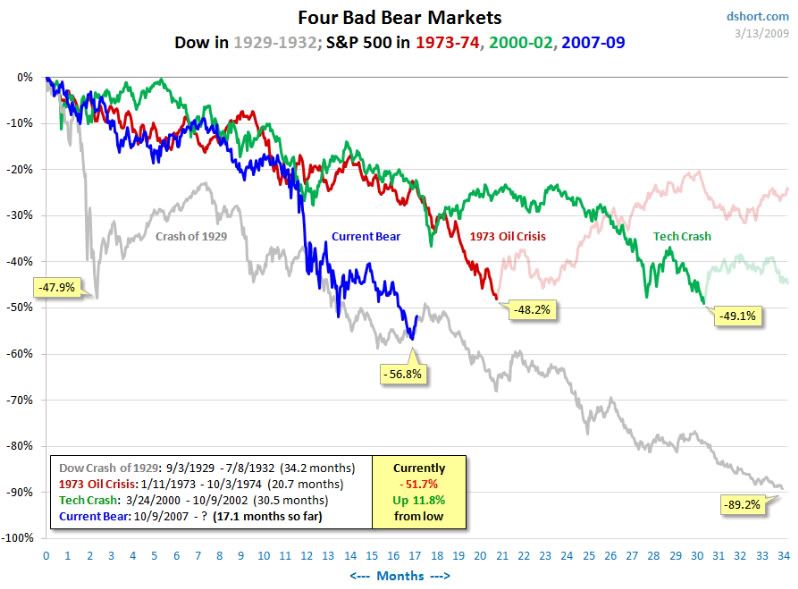
As evidenced by the chart, we have been here before, albeit for all different reasons. In the 1973-1974 downturn the trigger was the Arab Oil Embargo. The contraction of 2000-2002 was prolonged by 9-11. The current collapse has been frequently compared to the Great Depression. History will one day show that both may have been born of the same mother. Mark-to-market accounting rules caused banks to fail in the Great Depression, not from bad loans, but from writing down values at the behest of regulators. FDR eventually called together his economic panel in 1938 and suspended those rules. By then the Depression had lasted eight years, despite public works (WPA) and large spend projects like the Hoover Dam.

At the epicenter of the current storm, mark-to-market a/k/a "fair value" accounting once again is center stage. The principles of fair value--also known as "mark-to-market"--accounting are described in the Statement of Financial Accounting Standards (SFAS) No. 157, which was adopted by FASB in 2006 for use after Nov. 15, 2007. Fair value measurements rely on exchange prices between market participants in orderly transactions. The system replaces historical cost accounting, which had been standard since 1938. The previous version required preparers to book assets at their original cost, and to mark them down where they deemed a permanent impairment--but never to mark them up.

When SFAS No. 157 was first adopted, about a year before the meltdown, it was considered relatively uncontroversial. Lawmakers, regulators and the financial sector blame fair value rules for the destruction of banks' balance sheets, while opposing forces maintain that marking to market helps protect investors by reflecting economic conditions, harsh as they may be. After all, the overarching purpose of accounting is to provide useful information that is reliable and relevant to decision makers. William Isaac, chairman of the FDIC from 1981 to 1985, has been a vocal champion for returning to historical cost. He argues we had a perfectly good working system before they decided to impose this grand experiment. He cites a suite of correspondence in the early 1990s from Alan Greenspan, then-Secretary of the Treasury Nicholas Brady, and Bill Taylor, chairman of the FDIC, all expressing alarm that market value accounting could lead to misleading and volatile bank earnings. It could even result in "more intense and frequent credit crunches, since a temporary dip in asset prices would result in immediate reductions in bank capital and an inevitable retrenchment in bank lending capacity," Brady wrote to the FASB on March 24, 1992 . Sixteen years, later, that is exactly what happened as evidenced by the destruction of hundreds of billions of bank capital.

Depending on the intention, there are different ways to hold financial instruments. Are they to be sold, traded or retained? Fair value does not apply to those assets held to maturity rather than in trading accounts. Suppose a bank has issued a loan to a real estate developer. Even if the development is in trouble, as long as the bank intends to hold the loan to maturity and has the ability to do so, it does not have to mark it down at all unless the asset has been impaired, showing some evidence like a missed interest payment. It makes sense that banks or insurance companies should carry loans at book, rather than market value, as long as borrowers are making interest payments.

When the rules took effect last year, no one foresaw the unprecedented volatility to come. Some liquid stocks, like General Electric, have seen their share prices halved; most people would concede to an assumption that its price was fair a year ago, and is still fair today. Other securities, like the ABX index, which is composed of the longest duration, highest risk sub prime issues, have been disproportionately hammered.

Still other markets have simply dried up as buyers retreated en masse, leaving no quoted prices in active trading, or else gargantuan spread prices that reflect abnormal conditions. Many of the securities being marked down now are illiquid. Distressed or forced liquidation sales are generally not orderly, whereas some securities were never intended for sale at all. I believe that there will be a return to cash accounting and that will end the destruction of bank capital. That will also mark the end to the Great Panic of 2008. We are awash in a sea of opportunity with valuations seen once in a generation. If my thesis is correct and mark to market is the root cause of the systemic collapse of the shadow banking system, then the suspension, removal or revision of FASB 157 will usher in a period of material reflation. We will once again return to normalcy.

Sunday, February 1, 2009

Who Can you Trust?

Once again, greed has rocked the foundation of our financial system. It has led to dishonesty, outright theft, and pervasive emotional detachment, and has caused each of us to question every financial relationship we have.

Our trust in our financial institutions is gone.We have been deceived by Freddie Mac, Fannie Mae, Congress, the SEC, AIG, Citigroup, and most recently Bernard Madoff. Each of these, in its own way, has shown that the further away from the investor an institution is, the greater the emotional detachment,and the easier it is for the institution to betray its clients' trust.


In this environment, "transparency" becomes critically important. The literal derivation of "transparent" is "able to see through." In financial relationships, it means the ability of the client to actually see the activities their financial services provider is undertaking on their behalf.

We have established and structured CoreStates to have multiple checks and balances that insure complete transparency. We have leading independent custodians safeguarding our clients' assets. We require our managers to have certified independent audits and peer reviews. An unaffiliated third party conducts the accounting for our clients' assets and generates the account statements that are provided directly from them to our clients. And, our clients maintain total 24/7 access to their account statements online. In other words, our clients are "able to see through" to each and every action taken in their accounts.

What that means to us at CoreStates is that everything we do and every decision we make is visible to our clients, and must be in their best interests.

That commitment to always act in our clients' best interests is what makes us a fiduciary. By law, fiduciaries are required to act in the best interests of the investor. We are held to a higher standard than are brokerage firms' registered representatives. We are the stewards of our clients' wealth. We ask our clients to be Serious Investors, and we demand that we be Serious Advisors.

Great companies, just like great people, are guided by a core set of values that provide a foundation for their beliefs and their behavior. The following are CoreStates' CoreValues. They have been guiding our conduct since the very beginning of CoreStates.
- We value lifetime client relationships.
- We value the family, respecting its long-term generational needs.
- We value honesty and integrity, the cornerstones of business and personal relationships.
- We value the power of transparent communication, the catalyst for trust.
- We value teamwork, the collaboration of individual initiatives and opinions.
- We value quality, if it's worth doing, it's worth doing right.
- We value education, the foundation for a lifetime of personal growth.
- We value the impact of partnerships, the blending of professional skills to solve client problems.
- We value extraordinary service, viewing what we do through the eyes of the client.
- We value diverse opinions, the foundation for the best investment decisions.

We realize that each and every one of our clients is guided by their own personal values. Over the past 30 years we have gotten to know and respect those guiding principles. The ideal financial relationship is a collaboration of like-minded people
guided by common values and objectives. As we move forward through 2009, I invite you to become more involved with every aspect of CoreStates. We have created one
of the industry's most instructive websites at www.corestates.us. We are proud of our efforts to keep clients informed, in touch and feeling secure about their
investments and their relationship with CoreStates.